What Does 925 Mean on Jewelry? Sterling Silver Explained
925 means sterling silver: 92.5% pure silver. How to read silver hallmarks, spot plated metal and tell if silver is real at home.
In this guide
- 01What does 925 mean on jewelry, exactly?
- 02925 vs 999, 958 and 800: other silver fineness marks
- 03Stamps that do not mean silver: EP, EPNS and "silver tone"
- 04How to read a sterling silver hallmark in the UK, France and the US
- 05How to tell if silver is real at home
- 06When to ask a jeweler
- 07Is 925 silver good for everyday jewelry?
- 08FAQ
If you have ever turned a ring over and wondered what does 925 mean on jewelry, the answer is more precise than the tiny stamp suggests: it states how much pure silver the metal contains. That number is one of the most useful clues you have when you buy, inherit or resell a piece.
This guide explains what the stamp means, how it compares with other silver marks, which hallmarks to look for in the UK, France and the US, and the simple checks that help you tell real silver from plated metal, with the honest limits of each one.
Short answer: 925 means the metal is sterling silver: 925 parts out of 1,000, or 92.5%, are pure silver, and the remaining 7.5% is another metal, usually copper, added for strength. The number is a fineness mark applied by the maker; an assay office hallmark or a jeweler's test is what confirms it.
What does 925 mean on jewelry, exactly?
Precious metal purity is expressed in parts per thousand, also called millesimal fineness. A stamp reading 925 means that out of every 1,000 parts of the alloy, 925 are pure silver. The remaining 75 parts are other metals, most often copper, sometimes with small amounts of zinc or germanium in modern alloys.
Why not use pure silver? At 99.9% purity, silver is soft: a thin ring bends, prongs open and clasps wear quickly. A small share of copper makes the metal harder and better at holding its shape and its polish, while keeping the bright white shine people expect from silver.
That alloy has a name: sterling silver. So the 925 sterling silver meaning is simply silver at the sterling standard of 92.5%. Seeing both "925" and "Sterling" on the same piece is common and slightly redundant, since each tells you the same thing.
925 vs 999, 958 and 800: other silver fineness marks
925 is the most common standard for jewelry worldwide, but it is not the only one. Here is how the main numbers compare.
| Stamp | Pure silver | Usual name | Where you see it |
|---|---|---|---|
| 999 | 99.9% | Fine silver | Bullion bars and coins, some handmade jewelry |
| 958 | 95.8% | Britannia silver | British silverware and some jewelry |
| 950 | 95% | Former French first standard | Antique French silverware |
| 925 | 92.5% | Sterling silver | Most silver jewelry sold today |
| 900 | 90% | Coin silver | Older US coins and flatware |
| 800 | 80% | 800 silver | Older German, Italian and French silverware |
A lower number is not a defect: 800 silver is harder and was widely used for cutlery and boxes. It simply contains less silver, tends to darken a little faster and is worth less by weight. A higher number means a softer metal, better suited to chunky designs than to fine chains or thin bands.
Stamps that do not mean silver: EP, EPNS and "silver tone"
Some marks look official but tell you the piece is plated, or contains no silver at all. Learn to spot them before paying a silver price.
- Sterling, STER, STG: abbreviations for sterling silver, equivalent to 925.
- EP: electroplated, meaning a thin layer of silver over a base metal.
- EPNS: electroplated nickel silver. Nickel silver is an alloy of copper, nickel and zinc that contains no silver; only the surface layer does.
- SP, Silver plated, Silverplate: plated, whatever the thickness.
- German silver, Alpaca, Nickel silver: trade names for silver-colored alloys with no silver content.
- Silver tone, silver color: describes the color only, not the metal.
One more case confuses many buyers: a gold-colored piece stamped 925. That stamp describes the base, which is sterling silver covered with a layer of gold. Depending on the thickness of that layer, it may be sold as vermeil or as gold-plated silver. A dedicated guide compares gold vermeil, gold filled and gold plated layer by layer.
How to read a sterling silver hallmark in the UK, France and the US
A number stamped by the maker and a hallmark struck by an independent assay office are not the same thing. Which one you find depends on where the piece was made or sold.
United Kingdom
British hallmarking is among the strictest in the world. A full sterling silver hallmark combines a sponsor's mark (the initials of the maker or importer), the fineness mark 925, and the symbol of the assay office that tested it: a leopard's head for London, an anchor for Birmingham, a rose for Sheffield, a castle for Edinburgh. Many pieces also carry the lion passant, the walking lion that has traditionally signaled sterling in England. Silver items under 7.78 g are exempt, so a very light pair of studs may legitimately have no hallmark.
France
In France, the guarantee mark for silver is the head of Minerva, in use since 1838. On older silverware, a 1 next to the head indicates the first standard (950 parts per thousand) and a 2 the second standard (800). Small objects and imported pieces can carry other symbols, such as the crab or the weevil. Next to it sits the maker's mark: inside a lozenge for solid precious metal, inside a square for silver-plated metal, which is the quickest way to tell French silver from plated tableware.
United States and elsewhere
The US has no government assay office. The quality mark is applied by the manufacturer, and federal law requires it to be accurate and to sit next to a trademark identifying who stands behind it. In practice, a stamp is only as reliable as the company that struck it. Countries that belong to the international Hallmarking Convention also recognize a Common Control Mark, a pair of scales shown with the fineness number.
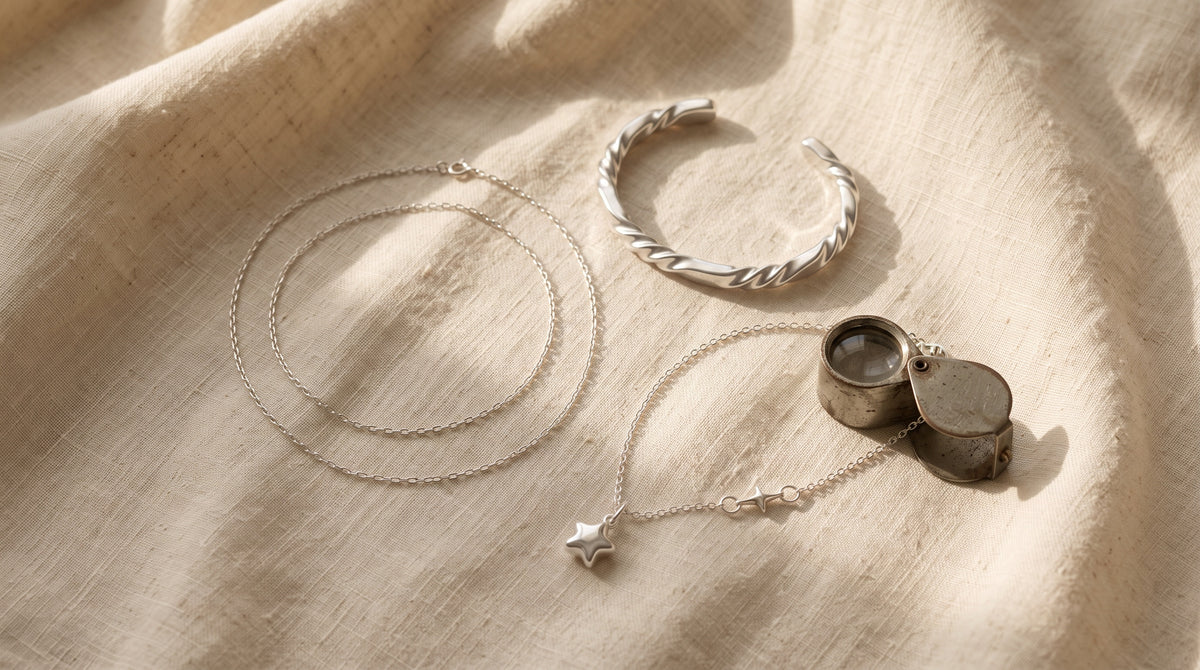
Where to look: inside the band of a ring, on the clasp or the small tag beside it on a necklace or bracelet, on the post or back of an earring. A 10x loupe helps, because these marks are often less than a millimeter tall.

How to tell if silver is real at home
No home test is conclusive on its own. Used together, they quickly rule out obvious fakes. Start with the least invasive.
1. The magnet test
Silver is not magnetic. Hold a strong magnet (a small neodymium magnet works better than a fridge magnet) against the piece: if it snaps on firmly, the item is mostly steel or iron underneath. A slight pull at the clasp is normal, since clasps often hide a tiny steel spring. The limit: copper, brass, aluminum and many plated alloys are not magnetic either, so passing this test proves nothing by itself.
2. The ice test
Silver conducts heat better than any other metal. Place an ice cube on a flat silver surface and another on stainless steel: the cube on silver starts melting almost at once, as if it were resting on something warm. It works well on bangles, cuffs and spoons, much less on thin rings or chains, which are too small to show a clear difference.
3. The white cloth test
Rub the piece firmly with a soft white cloth. Real silver usually leaves gray or black marks, the tarnish that forms when silver reacts with sulfur in the air. The limit: silver-plated items leave the same marks, while silver that has been rhodium plated or freshly cleaned leaves none.
4. Tarnish over time
Silver darkens slowly, faster in a humid bathroom or near wool and rubber. A silver-colored piece that never changes after years of wear is often stainless steel or rhodium-plated metal. That is not a flaw, just a different material.
What not to do
- Do not scratch the piece with a file or a knife: it damages plating and resale value.
- Do not use bleach: it attacks silver and leaves a dull dark film that is hard to remove.
- Avoid home acid kits on plated or delicate jewelry unless you accept a small visible mark.
When to ask a jeweler
For anything valuable, inherited or bought secondhand at a silver price, a professional test is worth the visit. A jeweler can run an acid test on a touchstone, which needs a tiny streak of metal rubbed off in a discreet spot, or use an XRF analyzer, which reads the metal composition in seconds without damaging it. XRF measures the surface, so a thick plating can still mislead it, and a good jeweler will often combine methods.
The same logic applies to gold, with karats instead of parts per thousand. If you also have yellow pieces to check, see how to tell if gold is real, which walks through the stamps and tests for gold.
Is 925 silver good for everyday jewelry?
Sterling is a durable everyday metal: hard enough for rings and chains, easy to polish and repair, and resizable by a jeweler. Its main drawback is tarnish. Perfume, chlorine, sweat and humid air all speed it up, while storing pieces in a closed pouch slows it down.
When it does darken, a polishing cloth or a gentle soak usually brings it back. The step-by-step guide to cleaning silver jewelry covers which methods are safe and which ones strip plating.
Skin sensitivity is a separate question. Pure silver rarely causes problems, but the 7.5% of other metals varies from one maker to another, and some low-quality alloys or plated base metals contain nickel. If certain earrings make your skin react, the guide to hypoallergenic jewelry explains which metals to look for, and a dermatologist can confirm a nickel allergy.

If you simply love the cool shine of white metal, build around a few simple shapes: a fine silver chain necklace for every day, a twisted silver bangle that sits well next to a watch, or a mariner chain for a bolder look. Each Talisse product page lists its own materials, so check the details rather than relying on color alone. You will find more silver-tone pieces among the women's jewelry and men's jewelry collections.
FAQ
Can a piece stamped 925 be fake?
Yes. A stamp is easy to strike, and counterfeit 925 marks are common on cheap plated jewelry sold online. Treat the number as a claim, then check it with the magnet, ice and cloth tests, or with a jeweler's acid or XRF test for anything valuable.
Is 925 silver real silver?
Yes. Sterling is real silver alloyed with a small share of another metal for strength. It is the standard used by most jewelers and silversmiths, while 999 fine silver is mostly reserved for bullion and some soft handmade pieces.
Does 925 silver turn your skin green?
Rarely. This alloy can leave a faint gray mark when it tarnishes against damp skin, and it washes off with soap. A clear green ring is more typical of copper-rich alloys such as brass, or of plating that has worn through to the base metal.
What does 925 Italy mean?
It means the piece is sterling silver made in Italy, a country with a large silver chain industry. Italian pieces often carry an extra code made of a star, a number and a province abbreviation, which identifies the registered maker.
Is 925 silver worth anything?
Its metal value is based on the pure silver it contains, so 92.5% of the piece's weight at the current silver price, which stays modest for light jewelry. Design, craftsmanship and the maker's name usually count for more than the metal itself when you resell.