What Is Gold Vermeil? Vermeil vs Gold Filled vs Gold Plated
Gold vermeil, gold filled and gold plated explained with the real standards: base metal, gold thickness, tarnish, lifespan and how to choose.
In this guide
- 01What is gold vermeil?
- 02What is gold filled jewelry?
- 03What is gold plated jewelry?
- 04Gold vermeil vs gold plated vs gold filled: comparison
- 05Does gold plated jewelry tarnish?
- 06How long does gold plated jewelry last?
- 07How to make gold plated and vermeil jewelry last longer
- 08Which one should you choose?
- 09FAQ
What is gold vermeil, and how is it different from gold filled or gold plated jewelry? All three labels describe a layer of gold over another metal, but the thickness of that layer, the metal underneath and the rules behind each name are very different.
This guide explains each term with the actual standards, compares them side by side, and answers the questions people ask most often: whether gold plated jewelry tarnishes, how long it lasts, and how to keep any gold-toned piece looking good for longer.
Short answer: Gold vermeil is sterling silver coated with gold of at least 10 karats and at least 2.5 microns thick, under US rules. Gold filled bonds a much thicker gold layer, at least 1/20 of the total weight, to a base metal. Gold plated is a thin electroplated film, usually over brass or copper.
What is gold vermeil?
In the United States, the Federal Trade Commission's Jewelry Guides set three conditions for the word "vermeil": the base must be sterling silver (92.5% pure silver), the gold coating must be at least 10 karat, and it must be at least 2.5 microns thick. If one of the three is missing, the piece should not be sold as vermeil.
A coating of 2.5 microns is still thin, roughly one-fortieth of the thickness of a sheet of office paper. But it is many times thicker than the flash plating found on most costume jewelry, and it sits on a precious metal rather than on brass.
Vermeil in France and the rest of Europe
The word does not mean exactly the same thing everywhere. In France, "vermeil" is a regulated term for silver of at least 925 parts per thousand covered with gold at least 5 microns thick, twice the American minimum. Other European countries have their own rules, so the label alone tells you less than the stated karat and thickness.
Strengths and limits of vermeil
- Precious metals throughout: a silver core and a gold surface.
- A coating thick enough to handle regular wear far better than flash plating.
- The gold still wears with friction, and once it thins, the silver beneath can tarnish and show through as a grayish patch.
- Silver is a soft metal, so very fine vermeil rings can bend out of shape.
What is gold filled jewelry?
Gold filled jewelry has a thick layer of gold alloy, at least 10 karat, bonded to a base metal core (usually brass) with heat and pressure rather than by electroplating. Under the FTC guides, the gold must account for at least 1/20 of the item's total weight, which is why you will see stamps such as "1/20 12K GF".
Because the layer is mechanically bonded and comparatively thick, gold filled jewelry can take years of regular wear with basic care. The name is a little misleading: the piece is not filled with gold, the gold is on the outside.
A related label, "rolled gold plate" (RGP), uses the same bonding process with a thinner layer, often 1/40 of the weight. Both are mostly American categories, and you will rarely see them defined in European regulations.

What is gold plated jewelry?
Gold plated jewelry is made by electroplating: the piece is placed in a bath containing dissolved gold, and an electric current deposits a thin film onto the surface. The base is usually brass or copper, sometimes stainless steel or silver.
How thick is gold plating?
The FTC guides allow "gold electroplate" for a coating of at least 10 karat gold and 0.175 microns thick, and "heavy gold electroplate" from 2.5 microns. Much fashion jewelry carries a flash plating that is a fraction of a micron. In France, "plaqué or" is a regulated term that requires at least 3 microns of gold; anything thinner must be sold as "doré" (gold-tone).
Plating also comes in different shades: high-karat gold gives a deep yellow, while lower-karat alloys look paler or rosier. Some makers add a clear protective layer on top to slow wear, which helps but also eventually wears off.
Gold vermeil vs gold plated vs gold filled: comparison
Here is how the three compare. Thicknesses are US legal minimums, not a guarantee for any given piece; always check what the seller actually states.
| Gold vermeil | Gold filled | Gold plated | |
|---|---|---|---|
| Base metal | Sterling silver | Usually brass | Brass, copper, steel or silver |
| Gold layer (US minimum) | 10 karat, 2.5 microns | 10 karat, 1/20 of total weight | 10 karat, 0.175 microns ("gold electroplate") |
| How it is applied | Electroplating | Heat and pressure bonding | Electroplating |
| Resistance to daily wear | Good | Very good | Low to fair, depends on thickness |
| Common marks | 925 | GF, 1/20 12K GF | GP, GEP, HGE |
| Relative price | Mid-range | Mid-range | Lowest |
Gold vermeil vs gold plated
Both are electroplated, so the difference lies in what is under the gold and how much gold there is. Vermeil requires a silver core and a coating of at least 2.5 microns; ordinary plating has no required base and can be far thinner. When vermeil wears, silver appears; when cheap plating wears, the yellow or reddish tone of brass or copper shows through.
Gold filled vs gold plated
Gold filled contains much more gold, at least 5% of the weight, in a layer that is bonded rather than deposited. It resists scratches and friction far better, which is why it is popular for chains and earring wires worn every day. Gold plated pieces cost less and come in more designs, but they need gentler handling and eventually a replating.
Does gold plated jewelry tarnish?
Pure gold does not tarnish, but gold plated jewelry can change color over time. Three things are usually at work: friction thins the coating until the base metal is exposed; the exposed brass or copper reacts with air, sweat and skin oils and darkens or turns greenish; and with very thin plating, atoms from the base metal can slowly migrate into the gold layer and dull it.
Lower-karat gold alloys also contain silver and copper, which can darken slightly. Vermeil has a related weak point: where the gold is worn or porous, the silver underneath can tarnish. The green mark some people notice on their skin comes from copper reacting with sweat, and it washes off with soap and water.
Stainless steel, often used as a base for plating, resists corrosion much better than brass. To know what to expect from it, read whether stainless steel tarnishes.
How long does gold plated jewelry last?
There is no single answer, because it depends on the thickness of the gold, the type of piece and how it is worn. As a rough guide, a flash-plated piece worn every day can show wear within weeks to a few months, while plating of 2.5 microns or more can keep its color for a year or longer with care. Gold filled jewelry can last many years.
What wears plating fastest
- Friction: rings and bracelets rub against desks, bags and each other, so they wear sooner than earrings or pendants.
- Chemicals: perfume, hairspray, lotion, sunscreen, chlorine and salt water.
- Sweat and humidity, especially during sport or in hot weather.
- Abrasive cleaning: polishing compounds, toothpaste or baking soda remove gold along with the dirt.
How to make gold plated and vermeil jewelry last longer
- Put jewelry on last, once perfume, lotion and makeup have dried.
- Take it off before showering, swimming, exercising, cleaning or going to bed.
- Wipe each piece with a soft, dry microfiber cloth after wearing to remove sweat and oils.
- Clean occasionally with lukewarm water and a drop of mild soap, rinse, then dry completely. The full routine is in this guide on cleaning gold jewelry at home.
- Store pieces separately in a dry pouch or lined box so they don't scratch each other; an anti-tarnish strip helps protect vermeil.
- Rotate pieces rather than wearing the same ring every single day.
When the coating is worn through, most pieces can be replated by a jeweler. It is usually worth it for vermeil and well-made pieces; for inexpensive fashion jewelry, replating can cost more than the piece itself.

Which one should you choose?
- Gold filled if you want pieces to wear daily, such as chains and earrings you rarely take off, and value durability over variety.
- Gold vermeil if you want precious metals throughout or prefer a silver core to brass. If you have a known metal allergy, check the full composition and talk to a dermatologist if reactions persist.
- Gold plated if you like to follow trends, change pieces often or want a gift at a lower price. Choose thicker plating when the seller states it, and treat the piece gently.
Whatever you choose, look for figures rather than labels: karat, microns or fraction of weight, and the base metal. A seller who lists them is easier to trust than one who simply says "gold". To check a piece you already own, see how to tell if gold is real.
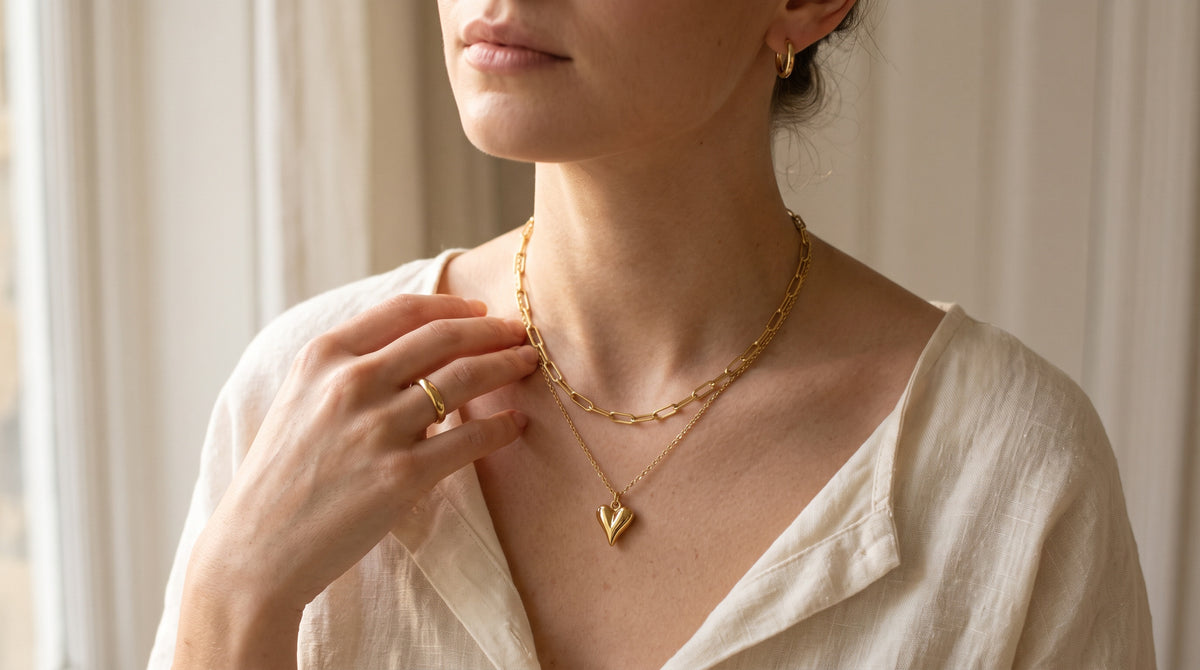
Gold-tone jewelry is also an easy way to try a look before investing more: a fine pendant from the necklaces collection, a gold heart necklace for every day, small huggie earrings or a simple gold band ring worn with care will give you a good idea of what suits you.
FAQ
Is gold vermeil real gold?
Yes, the surface is real gold of at least 10 karats under US rules, over a sterling silver base. It is not gold all the way through, so it is priced well below a piece made entirely of gold alloy.
Can you shower with gold vermeil or gold plated jewelry?
It is better not to. Water alone does little harm, but soap, shampoo and hot water speed up wear of the coating and can dull the silver underneath. Take pieces off and put them back on once you are dry.
What do GP, GEP and HGE stamps mean?
GP means gold plated, GEP gold electroplate, and HGE heavy gold electroplate, the last indicating a coating of at least 2.5 microns under FTC guidelines. A karat number next to these marks refers to the gold used for the coating, not to the whole piece.
Is gold filled better than vermeil?
For durability, gold filled usually comes out ahead, because its gold layer is thicker and bonded with heat and pressure. Vermeil has the advantage of a precious metal core and is common in more delicate designs. Both are a clear step up from flash plating.