
Signet Ring Meaning: History, Which Finger and How to Wear It
Signet ring meaning, from wax seals to family crests: which finger and hand to choose, how men and women wear one, and what to engrave.
In this guide
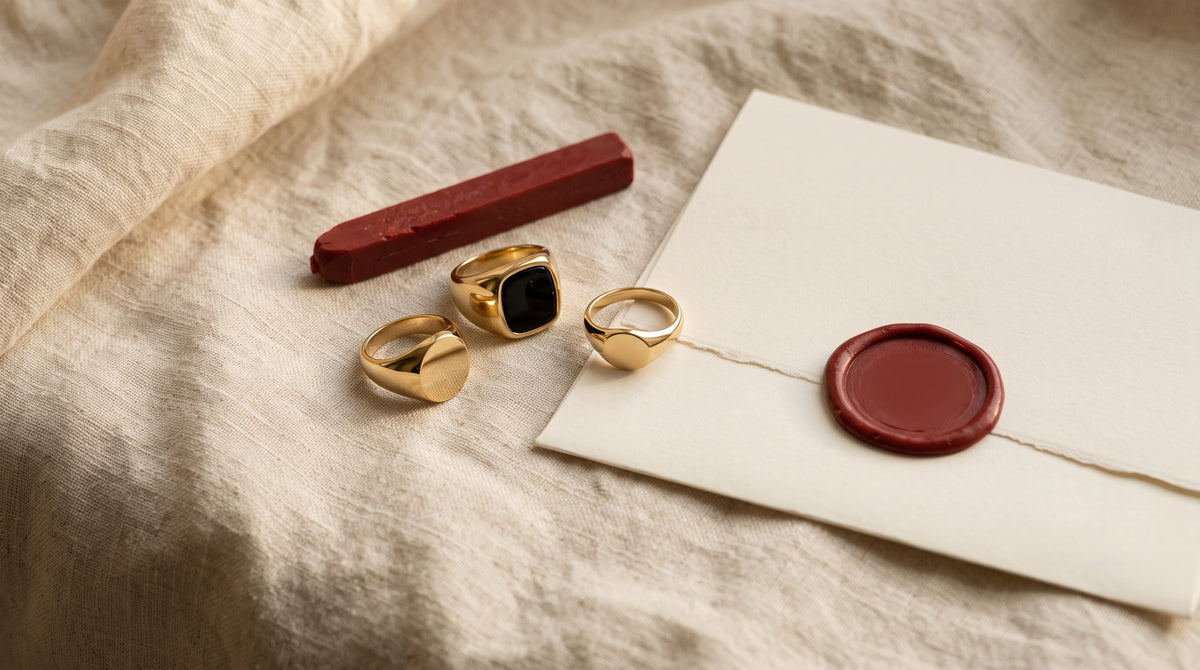
The signet ring meaning goes back thousands of years: before handwritten signatures were common, a ring engraved with a personal emblem was how people sealed letters, approved contracts and proved who they were. Today it is worn as a mark of family, of a milestone, or simply of personal style.
This guide covers where signet rings come from, what they mean now, which finger and hand to choose, how to wear one as a man or a woman, what to engrave and how to get the size right.
Short answer: A signet ring was originally a seal: its engraved face was pressed into wax to authenticate documents. Today it symbolizes identity, family heritage or a personal milestone. Tradition places it on the little finger of the non-dominant hand, usually the left, but any finger is acceptable.
Where signet rings come from: a short history
The word signet comes from the Latin signum, a sign or mark. The object itself is far older than Latin.
Seals before signatures
In ancient Mesopotamia, officials and merchants used carved cylinder seals, rolled across wet clay to mark ownership or approve a transaction. In ancient Egypt, seals often took the form of scarabs or rings engraved with a name or title. Carrying the seal on the finger had an obvious advantage: it was always at hand, and hard to lose or borrow without the owner noticing.
Wax, coats of arms and authority
The Romans used sealing rings widely, and in medieval Europe they became the standard tool of nobles, clergy and merchants. The engraved face was pressed into hot wax on a letter or a deed: the impression identified the sender, and a broken seal showed that the document had been opened. As heraldry developed, many seals carried a coat of arms or a family crest. The best-known example is still in use: the Fisherman's Ring of the Pope, which is traditionally defaced when a pope dies so that it cannot be used to forge documents.
From tool to keepsake
As handwritten signatures took over and wax seals disappeared from daily correspondence, the ring lost its practical function but kept its symbolic one. In many families, especially in Britain and France, it became an heirloom passed from one generation to the next, or a gift marking adulthood.
What does a signet ring mean today?
A modern signet ring rarely seals anything, but it still says something about the person wearing it. The most common meanings are:
- Family and heritage: an engraved crest, coat of arms or family initial, often handed down.
- A milestone: a coming-of-age birthday, a graduation, a first job, a wedding or the birth of a child.
- Personal identity: your own initials or monogram, a symbol you chose, a meaningful date.
- Style: a plain, polished face simply because the shape is timeless.
Symbols carry their own traditional meanings. A lion has long stood for courage and strength in heraldry, which is why a lion signet ring reads as a bold, protective emblem. Dark stones such as onyx and carnelian were historically favored for engraved seals, and an onyx signet ring keeps that sober, classic look even without engraving.
One point of etiquette: heraldic tradition frowns on wearing a coat of arms that does not belong to your family. If you have no crest, initials or a personal symbol are entirely legitimate, and far more common.
Which finger for a signet ring?
There is no rule enforced by anyone, only traditions and practical considerations. The table sums up how each finger tends to be read.
| Finger | How it is usually read | Practical notes |
|---|---|---|
| Little finger | The classic placement, strongest tradition in the UK and France | Out of the way, rarely knocked; needs a smaller size |
| Ring finger | Can be mistaken for a wedding or engagement ring | Some wear it next to a wedding band |
| Middle finger | Central and balanced, less traditional | Larger size, very visible |
| Index finger | Confident, a modern statement | Gets more knocks in daily use |
| Thumb | Unconventional, fashion-led | Large size, best with a flat face |
The little finger became the default largely for practical reasons: a ring there does not get in the way of gripping or writing and can still be pressed into wax. For a broader look at what each finger has meant across cultures, see the guide to ring finger meanings.
Left or right hand?
Tradition puts the signet ring on the non-dominant hand, so the left for most people. The ring is less exposed to knocks there, and in the days of wax seals the writing hand stayed free. Left-handed people who follow the same logic wear it on the right.
Beyond that, comfort wins. If you already wear a wedding band on your left hand and find two rings on one hand crowded, the right little finger is a perfectly accepted alternative. The key is to choose a place and keep it, so the ring becomes part of your silhouette.
How to wear a signet ring as a man or a woman
Signet rings for men
The classic signet ring for men sits on the little finger of the left hand, alone or balanced by a wedding band on the ring finger. Match the face to the hand: a broad hand carries a larger oval or cushion face well, while slimmer fingers suit a smaller round or oval top. An oval signet ring is the most versatile shape, at ease with a suit as well as a T-shirt. More shapes, from plain faces to stones and motifs, are gathered in the men's signet rings collection.
Signet rings for women
Women have worn signet rings for as long as men, often with smaller faces. In English heraldry, a woman's arms were traditionally shown in a lozenge-shaped shield rather than a heater shield, which is why some women's signets have an elongated or angled face. Today the pinky signet is a popular way to wear a single gold piece every day, and a slim gold signet ring pairs easily with fine bands.
Stacking and mixing
- Keep one signet ring per hand: two flat faces side by side compete.
- Pair it with thin, plain bands on neighboring fingers rather than with another statement ring.
- Match the metal color to a watch or bracelet worn on the same hand for a calm, coherent look.
- Leave the finger next to it free if the face is large, so the hand does not look crowded.

Engraving: initials, crest or a plain face?
Engraving is what turns a signet ring into a personal object. You can also wear it plain and decide later, since a flat face can be engraved at any time by a jeweler.
Initials and monograms
One initial is the simplest choice. For a three-letter monogram, a common convention for an individual places the first-name initial on the left, the larger surname initial in the center and the middle-name initial on the right. Couples often combine two first-name initials.
Crests and seal engraving
A traditional seal engraving is cut in reverse and in depth, so that the impression in wax reads the right way round. This intaglio work is usually done by hand and takes longer than surface engraving, which reads directly on the ring. If you never plan to seal anything, surface engraving is simpler and easier to read.
Symbols and dates
A small emblem, a star, a date or coordinates work well on modern rings. A custom signet ring makes this easy without the formality of a family crest.

How to choose the right signet ring size
Signet rings are often worn on a finger you have never measured, which is the most common sizing mistake. The little finger is usually several sizes smaller than the ring finger, and fingers on the dominant hand tend to be slightly larger.
- Measure the exact finger you plan to use, at the end of the day when fingers are at their largest, with the help of a ring size chart.
- Aim for a snug fit. A heavy face makes a loose ring roll sideways, so the engraving ends up under the finger.
- A wide band feels tighter than a thin one of the same size; if the shank is broad, consider going up half a size.
- The ring should slide over the knuckle with slight resistance and not spin freely at the base of the finger.
If the ring turns out a little loose, there are simple fixes before resizing; this guide on how to make a ring smaller compares sizing beads, inserts and professional resizing.
FAQ
Can anyone wear a signet ring?
Yes. Signet rings have no legal or social restriction today. The only etiquette concern is wearing a coat of arms that belongs to another family; initials, symbols or a plain face are open to everyone.
What does a signet ring on the pinky mean?
It follows the oldest tradition: the little finger of the non-dominant hand was the practical place for a seal ring. Today it mostly signals a classic, understated taste rather than any specific status.
Is it OK to wear a signet ring without a family crest?
Absolutely. Most signet rings worn today carry initials, a symbol or nothing at all. A plain polished face is a classic choice in its own right and can be engraved later.
Can a woman wear a men's signet ring?
Yes, provided the size and the proportions suit her hand. A larger face worn on the index or the pinky can look striking; just check the band width and size, since men's rings are often cut wider.
How do you clean a signet ring?
Soak it briefly in warm soapy water and brush the engraving with a soft toothbrush, where dirt settles in the grooves. Rinse, then dry carefully, especially around a set stone.


