
How to Make a Ring Smaller: Quick Fixes and Resizing
Ring too big? Temporary fixes that work tonight, how a jeweler resizes a ring, which rings can't be resized and how to get the size right next time.
In this guide
- 01Is your ring too big? How to tell
- 02Check your size first: why fingers change size
- 03Quick fixes: how to make a ring smaller without resizing
- 04How to resize a ring at a jeweler
- 05Rings that can't be resized (or not easily)
- 06Wear it on another finger or stack it
- 07How to avoid buying a ring that's too big
- 08FAQ
If you are wondering how to make a ring smaller, the good news is that you rarely have to give up on a ring that slips or spins. Depending on how much too big it is and what it is made of, a few cents of silicone may solve the problem, or a jeweler may need to resize the band.
This guide starts by checking whether the ring is really too big, then goes through temporary fixes, professional resizing, the rings that cannot be resized and the simple habits that help you choose the right size from the start.
Short answer: For a quick, reversible fix, slip a silicone ring sizer adjuster or a ring guard onto the bottom of the band, or wrap it with tape or wax. For a permanent fix, a jeweler can cut out a small section of the band and solder it, or add sizing beads inside. Steel, tungsten and plated rings are much harder to resize.
Is your ring too big? How to tell
A ring that is a little loose is not always the wrong size. Fingers change size during the day, and a well-fitted ring should slide over the knuckle with slight resistance, then sit comfortably at the base of the finger.
Signs that a ring really is too big:
- It spins constantly, so a stone or motif ends up facing your palm.
- It slides over the knuckle with no resistance at all.
- It moves up toward the knuckle or slips off when your hands are cold or wet.
- You notice a visible gap between the band and the finger.
Top-heavy designs such as a gold signet ring or a ring with a large stone turn more easily than a plain band, even when the size is correct. In that case, a slightly snugger fit or a small adjuster usually helps more than a full resize.
Check your size first: why fingers change size
Before resizing anything, make sure the problem is the ring and not the moment you are wearing it. Fingers swell in heat, after exercise, after a salty meal or alcohol, and during pregnancy. They shrink in the cold and are often smallest in the morning. Your dominant hand is also often slightly larger than the other.
To get a reliable measurement, measure at the end of the day, at room temperature, and repeat it three or four times on different days. The full method, with a printable chart, is in this ring size chart and measuring guide.
For reference, here is how US sizes relate to inside diameter and circumference. Each full US size adds about 0.8 mm to the diameter and about 2.5 mm to the circumference.
| US size | Inside diameter | Inside circumference |
|---|---|---|
| 5 | 15.7 mm | 49.3 mm |
| 6 | 16.5 mm | 51.9 mm |
| 7 | 17.3 mm | 54.4 mm |
| 8 | 18.1 mm | 57.0 mm |
| 9 | 18.9 mm | 59.5 mm |
| 10 | 19.8 mm | 62.1 mm |
If your ring is less than half a size too big, a temporary fix is usually enough. From one size and up, professional resizing becomes worth considering.
Quick fixes: how to make a ring smaller without resizing
These solutions are inexpensive, reversible and do not touch the ring itself, which makes them ideal for rings that cannot be resized, for temporary swelling or simply while you decide.
Silicone ring sizer adjuster
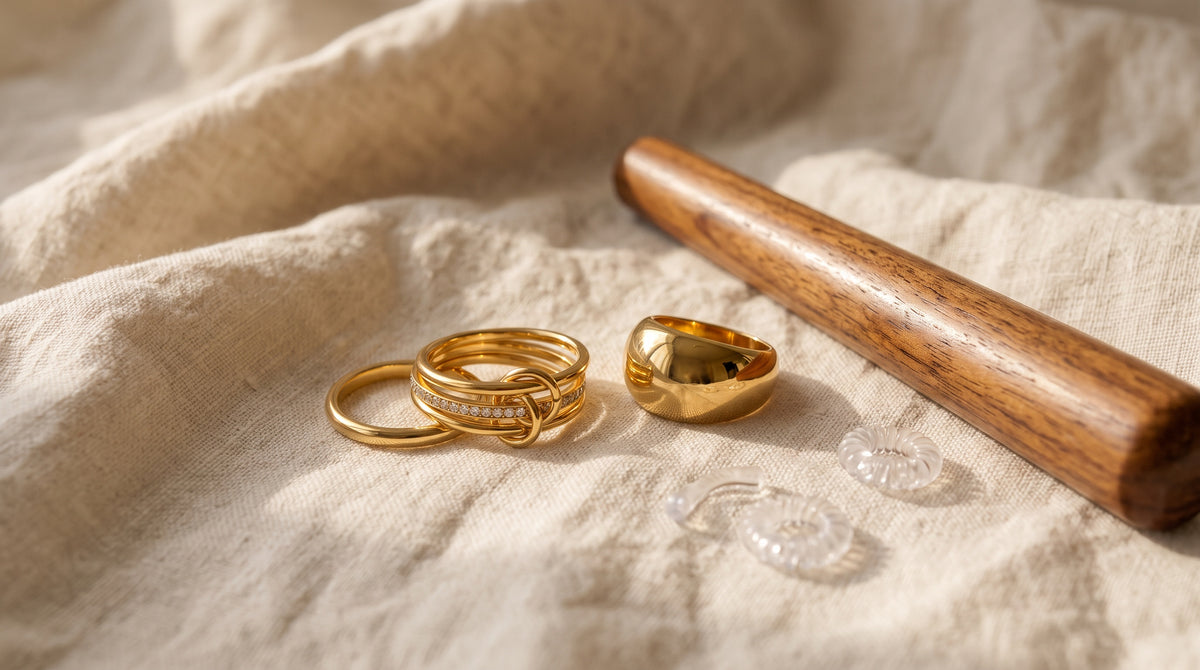
A ring sizer adjuster is a small clear silicone sleeve or spiral that clips around the bottom of the band. It is sold in sets of different thicknesses, so you can take up anything from a fraction of a size to roughly a size or two. It is nearly invisible, comfortable and gentle on the metal. On very thin bands it can show a little from the side.
Spiral or clip-on ring guard
Metal ring guards wrap around or clip onto the bottom of the band. They hold more firmly than silicone but can rub against the finger, scratch the inside of the ring and are less discreet. Avoid them on delicate plated rings.
Tape
Wrap a thin strip of medical or clear tape several times around the lower part of the band. It costs almost nothing and works for an evening, but it gets dirty quickly, loses grip in water and needs replacing often.
Wax
Ring sizing wax or a little beeswax pressed inside the bottom of the band fills the gap. It is invisible from above and easy to remove, but it softens with heat, collects dust and needs regular renewal.
A guard ring
A thinner band worn just above the loose ring keeps it in place. A slim gold band ring or gold interlocking rings can do the job while looking intentional. For ideas on combining bands, see how to stack rings.

How to resize a ring at a jeweler
For a ring you wear every day and that is clearly too large, professional resizing is the lasting solution. A jeweler will measure your finger, inspect the ring and tell you which method suits it.
Cutting and soldering
The most common method to make a ring smaller: the jeweler cuts the band at the bottom, removes a small section, closes the gap with solder and then reshapes and polishes the ring. Done well, the join is practically invisible. Most jewelers are comfortable going down one or two sizes this way; beyond that, the shape of the band and any stone settings can be stressed.
Sizing beads
Two small metal balls are soldered inside the bottom of the band. They reduce the space without cutting the ring and help a ring pass over a large knuckle, then stop it spinning at the base of the finger.
Spring inserts and sizing bars
A small spring-loaded or hinged insert is fitted inside the band. It opens to pass the knuckle and closes around the finger. This is a good option for people whose knuckles are much wider than the base of their fingers, for example with arthritis.
Resizing usually takes from a few days to two weeks depending on the workshop, and the price varies with the metal, the method and the number of stones. Ask for a quote before agreeing to the work.
Rings that can't be resized (or not easily)
Not every ring can be cut and soldered. Ask a jeweler before buying if you think you may need to change the size later.
- Stainless steel, tungsten and titanium. These metals are very hard and difficult to solder; most jewelers will not resize them.
- Eternity bands. When stones run all the way around, there is no plain section to cut.
- Plated rings. Cutting and soldering damages the plating, so the ring has to be re-plated afterward, which often costs more than the ring is worth.
- Patterned or engraved bands. A continuous pattern or inscription may be interrupted at the join.
- Tension settings and hollow bands. Their structure makes resizing risky or impossible.
For these rings, the temporary fixes above remain the best option, or wearing them on a different finger.
Wear it on another finger or stack it
Sometimes the simplest solution is to move the ring. Each finger has a different size: the middle finger is usually the widest, the little finger the narrowest, and the index sits in between. A ring that is too big for your ring finger may fit your middle finger perfectly.
Changing fingers can change the meaning a ring carries in some traditions, which matters for an engagement or promise ring. This guide on what each ring finger means covers the main customs before you decide.
Stacking is another option: two or three rings worn together hold each other in place, and a wider design such as a chunky dome ring grips the finger better than a thin band of the same size.

How to avoid buying a ring that's too big
- Measure the finger you will actually wear the ring on, not the one on the other hand.
- Measure at the end of the day, at a comfortable temperature, several times.
- Take the knuckle into account: if it is much wider than the base of the finger, choose a size between the two.
- For wide bands, roughly 6 mm and more, consider going up a quarter or half size, as they feel tighter than thin bands.
- For thin bands, between two sizes, the smaller one is usually more comfortable.
- Compare with a ring that already fits you well, measured on the inside.
Browse women's rings and men's rings with your measurement at hand to compare sizes before you choose.
FAQ
Can you make a ring smaller without a jeweler?
Yes, with temporary solutions: a silicone adjuster, a ring guard, tape or wax. They are reversible and do not damage the ring. Squeezing or hammering a closed ring at home is not advisable, as it can deform the band and loosen stones.
Does resizing damage a ring?
A resize done by a skilled jeweler on a suitable metal leaves an almost invisible join. Repeated resizing weakens the band over time, and plated rings lose their finish where they are cut and soldered.
Can you adjust an open or adjustable ring?
Open rings can be closed slightly by pressing gently and evenly on both ends. Do it a little at a time and not too often, as repeated bending fatigues the metal. Avoid this on rings with stones.
Why is my ring loose in winter?
Cold makes the blood vessels in your fingers contract, so fingers shrink slightly. A ring that fits in summer can feel loose in winter. A silicone adjuster is a good seasonal fix rather than a permanent resize.


