How to Wear Ear Cuffs: Placement, Fit and Styling
How to put on an ear cuff without pinching, where to place it on the ear and how to pair it with studs and hoops, with or without a piercing.
In this guide
Learning how to wear ear cuffs takes about a minute: the trick is to slide the cuff on where the ear is thinnest, then move it to its final spot and tighten it gently. Done this way, a cuff holds all day without pinching.
This guide explains the difference between an ear cuff and an earring, the exact steps to put one on and take it off, the best placements on the ear, and how to combine cuffs with studs and hoops for a balanced look.
Short answer: Open the cuff slightly, slide it onto the thinnest part of the outer ear, usually the middle of the rim just above the lobe, then glide it up to the spot you want. Squeeze it very gently until it holds without pressing. Take it off by reversing the steps.
What is an ear cuff? Ear cuff vs earring
An ear cuff is a small open ring or shaped band that wraps around the edge of the ear and holds by light pressure. Unlike an earring, it does not go through a piercing, so it can be worn anywhere along the ear's outer rim, also called the helix.
The ear cuff vs earring question comes down to fit and flexibility. An earring sits in a fixed hole and stays put. A cuff can be moved, removed in seconds and added to any ear, pierced or not. On the other hand, it relies on a good fit: too loose, it slips; too tight, it becomes uncomfortable within hours. For an overview of every style, from studs to threaders, see our guide to the different types of earrings.
How to put on an ear cuff, step by step
The upper ear is thicker and firmer than the middle of the rim. Pushing a cuff straight onto the top of the ear forces it open and can bend it. Follow this order instead:
- Find the thin spot. Run your fingers along the outer rim of the ear: the cartilage is usually thinnest in the middle, just above the lobe.
- Slide the cuff on there. Hold it by its sides with the opening facing the ear and slip the edge of the ear into the gap.
- Glide it into place. Move the cuff up or down along the rim to the position you want. Do not force it over thicker areas.
- Adjust gently. If it feels loose, squeeze the cuff very slightly between thumb and index finger. It should stay in place when you shake your head, without leaving a red mark.
To take it off, slide the cuff back down to the thin part of the ear and remove it from there, rather than pulling it off the top. Adjust the opening as little as possible: bending metal back and forth repeatedly weakens it.

How to wear ear cuffs: the best placements
Where you place the cuff changes the whole look. Here are the most common positions, from most discreet to most visible.
Middle of the rim
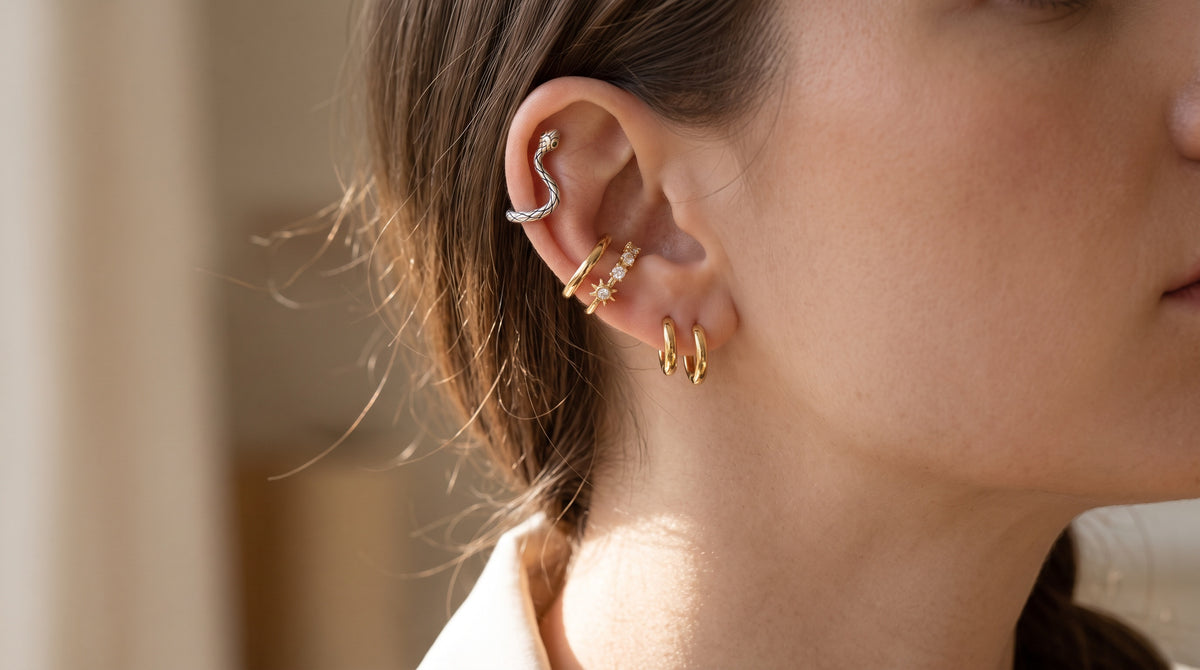
The easiest spot and the most comfortable for a first cuff. It is visible from the side and works with short or tied-back hair. A fine star ear cuff fits naturally here.
Upper helix
Higher up, toward the top of the ear, the cuff becomes a clear accent that frames the face. It suits a bolder shape such as a silver snake ear cuff that follows the curve of the ear.
Conch
Some cuffs are designed to sit across the inner part of the ear, the conch. This placement depends a lot on the shape of your ear: the cuff should rest without pressing on the cartilage.
Several cuffs on one ear
Two or three cuffs can be spaced along the rim, ideally in different widths. Leave at least a finger's width between them so they do not knock together.
Ear cuffs with no piercing vs ear climbers
Ear cuffs need no piercing at all, which makes them a good choice if you want a decorated ear without new piercings, or if you are not ready to commit to a cartilage piercing. Our ear cuffs collection is entirely made of pieces that clip onto the ear.
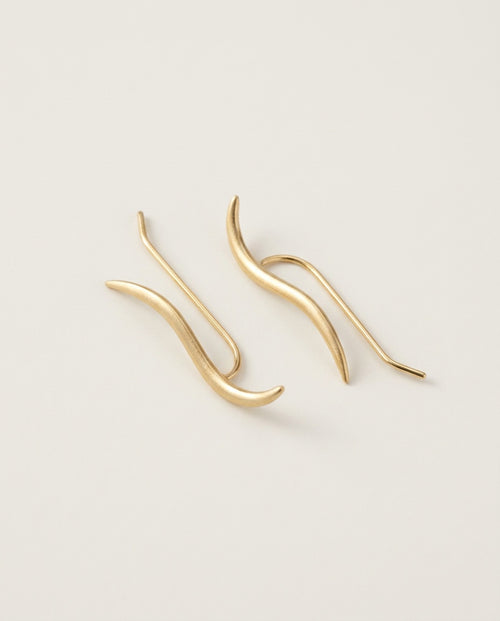
Ear climbers are often confused with cuffs. A climber is an earring: it goes through a lobe piercing, then runs up the edge of the ear, like our wave ear climber earrings. It gives a similar look but needs a pierced lobe. Some pieces combine both, such as an ear cuff chain linking a cuff to an earring.
Pairing ear cuffs with studs and hoops
A cuff rarely stands alone. A few simple rules keep the ear balanced:
- One focal point: if the cuff is wide or textured, keep the lobe simple with a small stud or a huggie.
- Vary the scale: a fine cuff next to a slightly bolder lobe earring gives depth.
- Stick to one metal tone per ear for a clean look, or mix gold and silver on purpose across several pieces.
- Think asymmetry: a cuff on one ear only is often more striking than a matching pair.
A pair of small huggie earrings in the lobe and a single cuff on the rim is one of the easiest combinations to wear every day.

Comfort, sleep and care
A well-fitted cuff should be forgotten after a few minutes. If it throbs, pinches or leaves a mark, loosen it slightly or move it to a thinner area. Take cuffs off before sleeping, as pressure on the pillow can hurt the cartilage and bend the piece, and before showering, swimming or sport.
Cuffs touch the skin all day, so clean them regularly following our advice on how to clean earrings. If your skin tends to react to certain metals, read the guide to jewelry for sensitive skin before choosing. Persistent redness, swelling or pain is a reason to remove the cuff and see a health professional.
FAQ
Do ear cuffs hurt?
A correctly adjusted ear cuff should not hurt. Discomfort usually means it is too tight or placed on a thicker part of the ear. Open it very slightly or move it lower along the rim.
Which ear should I wear an ear cuff on?
There is no rule. Many people wear it on the side they part their hair, so the cuff is visible, or on the ear that already has the fewest earrings.
Can ear cuffs fall off?
A cuff that is too loose can slip, especially when you take off a sweater or a hat. Check the fit by gently shaking your head; if it moves, tighten it a little.
Can I wear an ear cuff on a pierced ear?
Yes. Just place the cuff so it does not press against an earring or a healing piercing. Avoid placing it over a recent cartilage piercing until it has fully healed.