How to Layer Necklaces: Spacing, Lengths and 3 Easy Stacks
The spacing rule, the three-length formula, textures, pendants and mixed metals: how to build layered necklaces that look intentional and stay untangled.
In this guide
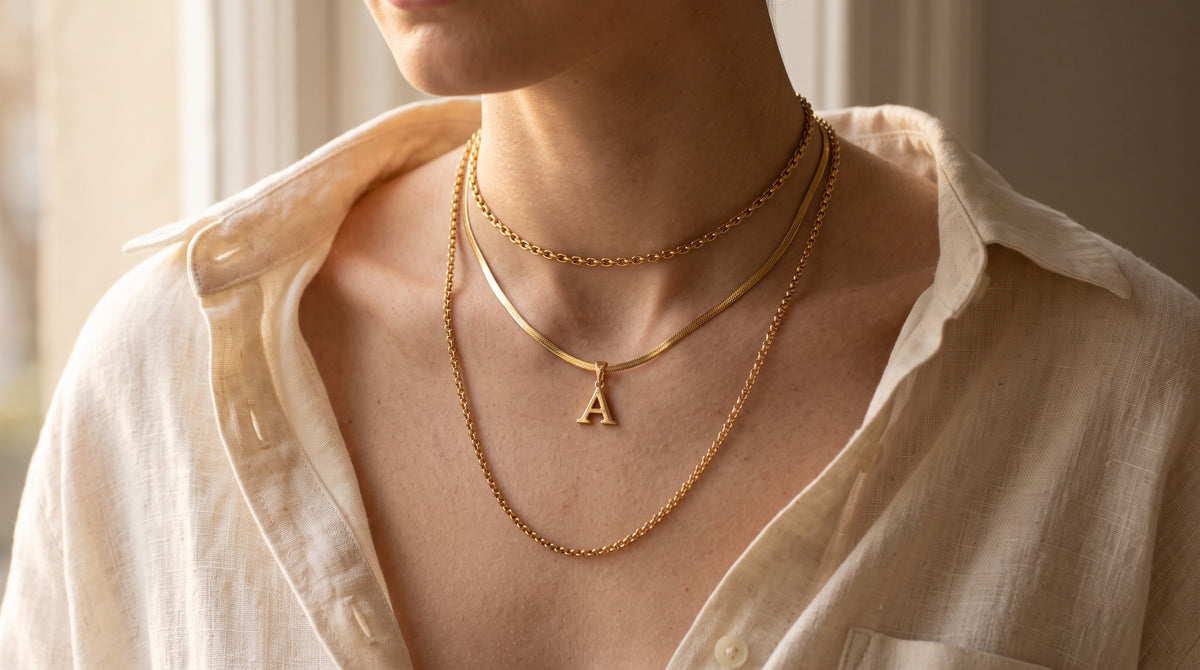
Knowing how to layer necklaces comes down to a few simple rules: space the lengths, vary the textures and give the eye one point to rest on. Done well, three fine chains look like a single, considered piece; done at random, they look crowded and end up in a knot.
This guide covers the spacing rule, how to choose lengths and chains, how to mix metals and pendants, and how to keep layers from tangling. It ends with three stacks you can copy as they are.
Short answer: To layer necklaces, start with three lengths spaced about 2 inches (5 cm) apart, such as 16, 18 and 20 inches or 16, 20 and 24 inches. Keep the shortest chain fine, put a single pendant in the middle or at the bottom, mix chain textures, and place the heaviest piece lowest to limit tangling.
How to layer necklaces: the spacing rule
Spacing is what separates layered necklaces from a tangle of chains. When two necklaces are less than about an inch apart, they overlap, hide each other and twist together. When each layer sits roughly 2 inches (5 cm) below the one above, every chain stays visible and the stack reads as a deliberate cascade.
Remember that a pendant adds its own drop. An 18-inch chain carrying a charm about an inch tall effectively ends an inch lower, so leave a little more room beneath any layer that has a pendant.
| Layer | Typical length | Where it sits | Best role |
|---|---|---|---|
| Top | 14–16 in (35–40 cm) | Base of the neck | Fine chain or choker |
| Middle | 18–20 in (45–50 cm) | On or just below the collarbone | Small pendant or textured chain |
| Bottom | 22–24 in (55–60 cm) | Upper chest | Focal pendant or heavier chain |
| Optional fourth | 28–30 in (70–76 cm) | Below the bust | Long chain over a high neckline |
Start with three lengths
Two necklaces can look like an accident; three create a clear rhythm. Odd numbers are easier on the eye, which is why three is the classic starting point for necklace layering.
- Choose the anchor. Pick the necklace you want people to notice, usually a pendant, and decide where it should land.
- Add a short, fine chain above it. A simple chain at 16 inches frames the neck without competing.
- Finish with a longer layer. Add a chain about 2 inches below the anchor, or a long chain at 24 inches or more for a stretched V.
- Check in a mirror. Look at the gaps rather than the pieces: they should be roughly even.
If you are unsure of your lengths, measure a chain you already own and compare it with our necklace length chart, which shows where each size usually falls on the body.

Mix chain textures and widths
Three identical chains at three lengths can look flat. Varying the texture gives depth even when everything is in the same color: a fine cable chain, a smooth snake chain and a flatter link each catch the light differently.
- Keep the finest chain at the top, closest to the face.
- Add one textured or slightly wider chain in the middle or at the bottom.
- Use beads or pearls as a single contrast layer rather than in every row.
Width works the same way: a 1 mm chain next to a 2 mm chain looks balanced, while a very chunky chain tends to dominate everything around it. If you want to know what sets a rope, figaro or snake link apart, our guide to chain types explains each style.
Choose one focal pendant
A layered look needs one star. Choose a single pendant, an initial, a coin or a small charm, and let the other layers act as a frame. Two pendants of similar size side by side compete for attention and tend to knot together.
The focal piece usually works best in the middle or bottom layer. In the middle, it sits on the collarbone and draws the eye toward the face; at the bottom, it creates a long V that lengthens the neck. Very small charms can go on the top layer as long as the lower layers stay plain.
Mixing metals in a gold necklace stack
Mixing gold and silver tones is no longer a styling mistake; it can make a stack look more personal and collected over time. The key is to make it look intentional.
- Repeat each metal at least twice across the look, in the stack itself or in your rings and earrings.
- Use a bridge piece that combines both tones, if you have one.
- Keep one metal dominant: two gold layers and one silver layer usually look more cohesive than an even split.
For an all-gold necklace stack, vary the finish instead: a polished chain, a textured chain and a pendant with a matte or engraved surface keep the tones from blending into one block of color.
Match layered necklaces to your neckline
The neckline decides how much of the stack is actually visible. As a rule, every layer should either sit on bare skin or fall clearly over the fabric, never right on its edge.
- V-neck: the ideal frame; let the layers follow the V and stop above its point.
- Crew neck: keep a short chain above the collar and let the longer layers fall over the top.
- Scoop or square neck: fine, closely spaced layers between 16 and 20 inches.
- Button-down shirt: open two buttons and wear two or three short layers inside the collar.
- Turtleneck: skip short chains and layer two long ones over the knit.
How to keep layered necklaces from tangling
Tangling is the most common complaint about layered necklaces, and most of it can be prevented. Very fine chains twist the most, especially when they are similar in weight and close in length.
- Respect the spacing. Chains less than an inch apart rub against each other with every movement.
- Put the heaviest piece lowest. Its weight keeps the bottom layer in place and limits twisting.
- Mix chain types. A snake chain or a flatter link rolls less than a fine cable chain.
- Use a layering clasp. A multi-strand clasp or necklace separator holds each chain in its own slot at the back of the neck.
- Try a pre-layered piece. A layered necklace with several strands on one clasp gives the look with a single fastening.
- Store chains separately. Hang them or keep each one in its own pouch, fastened.
If a knot does form, do not pull on it. Our method to untangle a fine chain uses a little oil and two pins to loosen it without damaging the links.
Three necklace stacks to copy
These combinations follow the rules above and use pieces from our collection. Adjust the lengths to your own neck, keeping the gaps roughly even.
The everyday gold stack
Start with our gold chain choker at 16 inches in the finer width. Add the gold initial necklace as the focal piece in the middle; check its length on the product page and keep about 2 inches between it and the choker. Finish with the gold long chain necklace at 24 inches for a clean V. This stack works with a simple tee as well as an open shirt.
The pearl and gold stack
Use the freshwater pearl necklace as the top layer, so the pearls sit close to the face. Below it, add a plain gold chain at 20 inches, then the oval long pendant necklace at the bottom as the focal point. The pearls bring texture, the pendant brings length, and the plain chain keeps the two apart.

The mixed metal stack
Wear our silver chain necklace in the 1.0 mm width at 16 inches, then a gold snake chain at 20 inches, then the silver chain necklace again in the 1.8 mm width at 24 inches. Silver at the top and bottom frames the gold in the middle, and the change in width keeps the two silver layers from looking repetitive.
FAQ
How many necklaces should you layer?
Two to four is the usual range, and three is the easiest place to start. Beyond four, the stack becomes harder to keep untangled and individual pieces start to disappear.
Can you layer gold and silver necklaces together?
Yes. Mixing metals is widely accepted today; it looks most intentional when one tone dominates and the other is repeated at least twice in the overall look.
Which necklace goes on first when layering?
Many people fasten the shortest necklace first and work down, so they can check each gap in the mirror as they go. If you use a multi-strand clasp, attach all the chains to it before putting it on.
What chains are best for layering?
Fine chains between about 1 and 2 mm wide are the easiest to layer, because they stay light and leave room for a pendant. Combining two different link styles, such as a cable chain and a snake chain, adds texture and reduces twisting.
Can men layer necklaces?
Yes. Men's layering usually uses two pieces rather than three, for example a chain at 20 inches and a pendant at 24 inches. The same spacing rule applies, with slightly longer lengths overall.