How to Untangle a Necklace: Step-by-Step, Even Tight Knots
How to untangle a necklace without breaking it: the pin method, a drop of oil for tight knots, what to avoid, and how to store chains so it never happens.
In this guide
Knowing how to untangle a necklace saves a lot of frustration, and often a chain you thought was ruined. Most knots come out with patience, a flat surface and two pins; the tight ones usually need a drop of lubricant.
Below you will find the exact method, what to do with a stubborn knot, how to adapt it to fine chains and pearls, and how to store necklaces so they stop tangling in the first place.
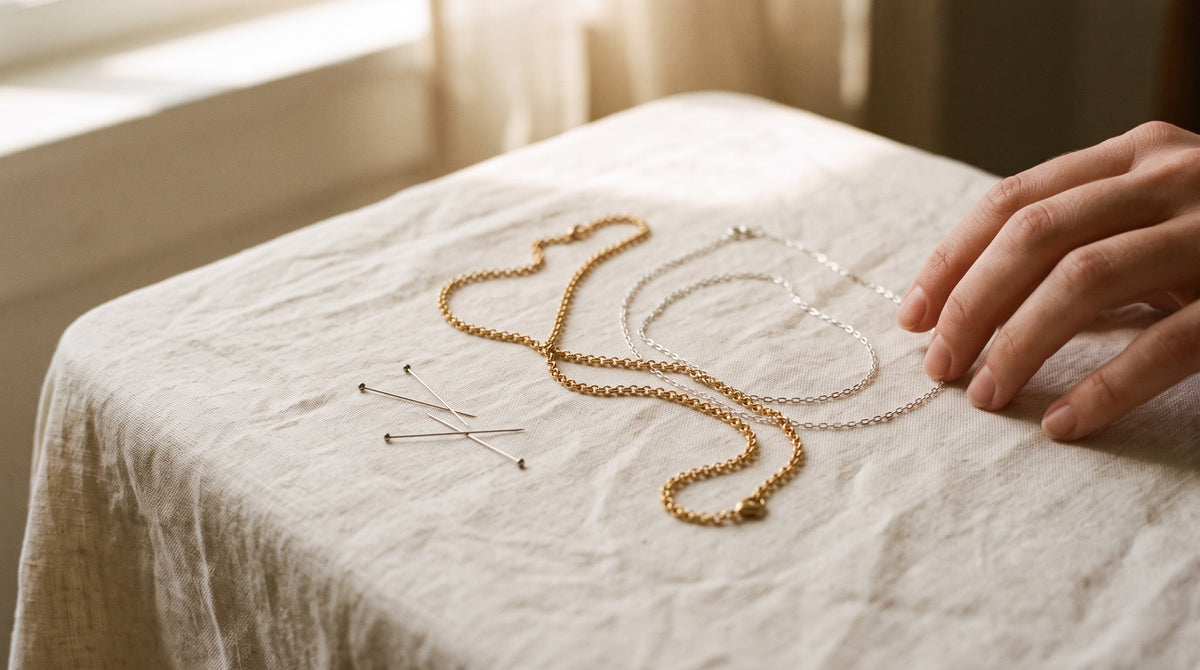
Short answer: Lay the necklace flat on a hard, light-colored surface and open the clasp. Insert two sewing pins into the center of the knot and gently pull them apart to loosen it, then work the loops free. For tight knots, add a drop of baby oil first, then wash the chain with mild soap.
Why do necklaces tangle?
Fine chains are made of hundreds of small, flexible links that move in every direction. When a necklace is tossed into a bag or a drawer, every movement lets the chain fold over itself, and the clasp or pendant pulls a loop through another.
Long and thin chains tangle the most, as do several necklaces stored together. Stiffer designs such as snake or rope chains tangle less, but they can kink instead. If you are not sure which style you own, this overview of the main types of chains will help you identify it.
What you need
- A flat, hard surface in good light, ideally white or pale so you can see the links.
- Two fine sewing pins or needles (a safety pin works too).
- A drop of baby oil, mineral oil or olive oil for tight knots.
- Cornstarch or talc as an oil-free alternative.
- A magnifying glass or your phone's camera zoom for very fine chains.
- Mild dish soap, lukewarm water and a soft cloth for cleaning afterwards.
How to untangle a necklace chain step by step
- Open the clasp and lay the necklace flat. An open chain gives the knot two free ends instead of a closed loop.
- Spread out the loose parts so the knot sits in the middle with the chain fanning out on each side. Do not pull on the ends: tension is what turns a loose tangle into a tight knot.
- Find the center of the knot and insert one pin, then a second right next to it.
- Pull the pins gently apart, in several directions, to open space inside the knot. Repeat from different angles until the loops loosen.
- Work the loops free one at a time, feeding the shorter end or the clasp back through the openings, rather than pulling the long part of the chain.
- Check the chain under good light for kinks or stretched links once it is free.
Keep the necklace on the table throughout. Lifting it lets gravity tighten the knot again.

How to get a knot out of a necklace that won't budge
When a knot is pulled tight, the links grip each other. A lubricant reduces that friction so the pins can do their work.
With a drop of oil
Put one drop of baby oil or olive oil directly on the knot and work it in by rolling the knot between your fingertips for a few seconds. Then use the pins as above. Once the chain is free, wash it in lukewarm water with a drop of dish soap, rinse and dry it completely with a soft cloth, otherwise the oil attracts dust.
With cornstarch or talc
If you prefer not to use oil, sprinkle a pinch of cornstarch or talc on the knot. It works more slowly but leaves nothing greasy; brush it off and rinse afterwards.
Methods to avoid
- Pulling hard on both ends, which tightens the knot and can snap a fine chain.
- Cutting the chain, unless you accept a repair at the jeweler.
- Scraping a gold-plated chain with metal tools: pins should push links apart, not scratch them.
- Soaking pearls, porous stones or leather cords in oil.
Fine chains, layered necklaces and pearls
A very fine chain, such as a delicate silver chain necklace, needs the lightest touch: use a magnifying glass, work with the tip of the pin only, and take breaks. On a layered necklace, separate the strands first, untangling the one with the most loops before the others.
A snake chain necklace rarely knots, but it can kink. Lay it flat and roll the kink gently between your fingers; do not fold it back the other way, which can crack the chain. Pearls strung on silk should not get oil or water: loosen the strand with a pin only, and if the knot is tight, ask a jeweler, who may restring it.
How to store necklaces so they don't tangle
Prevention is far easier than any untangling method. The principle is always the same: each chain stays straight, closed and separate from the others.
- Fasten the clasp before putting any necklace away.
- Hang them on a hook, a jewelry tree or a wall bar, one necklace per hook. This works especially well for long styles from the long necklaces collection.
- Use the straw trick for travel: thread the chain through a drinking straw, close the clasp outside it, and the chain cannot fold.
- Use separate compartments or small zip bags, leaving the clasp outside the bag.
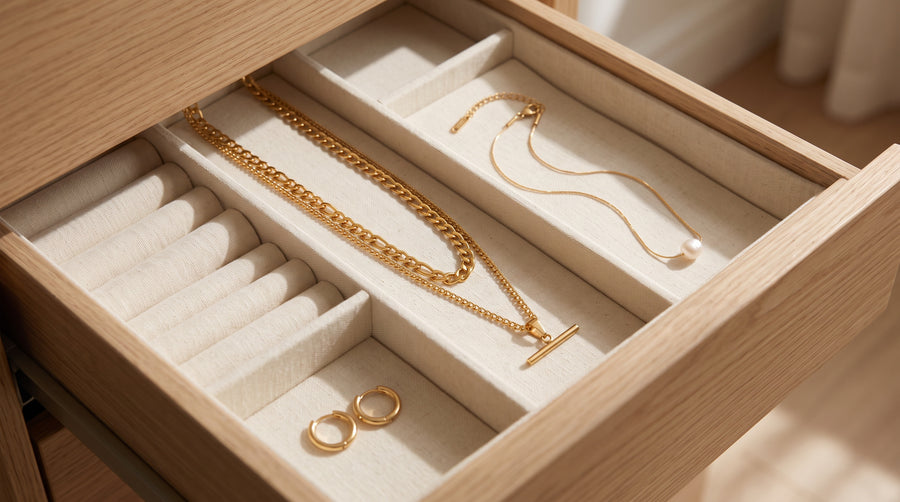
- Lay chains flat in a lined tray rather than piling them up.
For more ideas on boxes, drawers and travel cases, see our complete guide on how to store jewelry.

Wearing several necklaces at once is another moment when chains tangle. Spacing them about 2 inches apart, as explained in this necklace length chart, limits how much they rub and twist together.
FAQ
Can you untangle a necklace without a pin?
Yes. A toothpick, a straightened paper clip or the tip of a thin needle all work. The point is to have something fine enough to slip inside the knot and push the links apart without pulling the chain.
How long does it take to untangle a necklace?
A loose tangle usually takes a few minutes. A very tight knot on a fine chain can take much longer, and it is better to stop, rest your eyes and come back than to force it.
Does oil damage a gold necklace?
A drop of baby oil or olive oil does not harm gold or gold-tone metal, as long as you wash it off with mild soap afterwards. Avoid it on pearls, porous stones and textile cords.
Why does my necklace keep tangling when I wear it?
A pendant that spins, a chain that is very fine or several necklaces of similar length often cause it. A slightly heavier pendant, a sturdier chain or more spacing between layers usually helps.