Pearl Necklace Meaning: Symbolism, Types and How to Wear Pearls
What pearls symbolize, how to tell freshwater from Akoya or baroque, how to wear a pearl necklace today and how to care for it so it keeps its glow.
In this guide
The pearl necklace meaning people look for usually comes down to three ideas: purity, wisdom and lasting love. Pearls are the only gem grown by a living animal, and that slow, layered origin explains much of the symbolism attached to them across cultures.
This guide covers what a pearl necklace traditionally represents, the occasions linked to pearls, the main types you will meet, how to wear pearls today without looking dated, and the simple care that keeps them luminous.
Short answer: Traditionally, a pearl necklace symbolizes purity, wisdom and loyalty, which is why it is a classic bridal and coming-of-age gift. Pearls are also the June birthstone and the traditional gift for a 30th wedding anniversary. Today they are worn as a modern, everyday piece as much as a ceremonial one.
What does a pearl necklace mean?
A pearl forms when a mollusk coats an irritant with layer after layer of nacre. Many traditions read that process as a metaphor: something beautiful built patiently around a difficulty. Here are the meanings most often attached to pearls. They are cultural traditions, not properties of the stone.
Purity and new beginnings
Their soft white glow made pearls a symbol of innocence and purity in Western traditions. This is why a pearl necklace is a long-standing gift for a bride, a graduation or a first important birthday, often passed down from mother to daughter.
Wisdom and calm
Because a pearl grows slowly, it has long been associated with wisdom gained through experience. In several Asian traditions, pearls are also linked to the moon, to water and to calm, protective energy.
Loyalty and lasting love
A strand of pearls, made of many similar elements held together, is often read as a symbol of loyalty and family ties. Some old superstitions say pearls worn on a wedding day bring tears; others turn that around and say the bride has shed her tears in advance. Both are folklore, and pearls remain a favorite at weddings.
Pearls as June birthstone and 30th anniversary gift
Pearl is the traditional birthstone for June, alongside moonstone and alexandrite, so a pearl piece is a natural birthday gift for anyone born that month. If you are looking for other months, our guide to birthstones by month and their meanings lists each one.
Pearl is also the traditional gift for a 30th wedding anniversary, the pearl anniversary. A single pendant, a pair of earrings or a strand all fit the tradition; the gesture matters more than the size of the pearls.
Pearl jewelry types: freshwater, Akoya, Tahitian and baroque
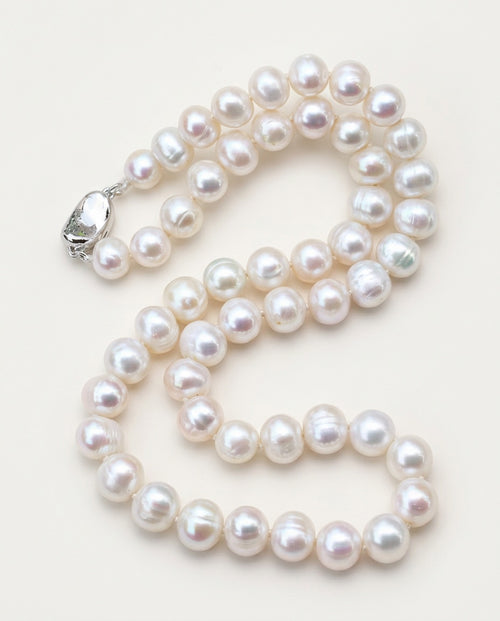
Almost all pearl jewelry sold today uses cultured pearls, meaning a person started the process by placing a nucleus or a piece of tissue inside the mollusk. Natural pearls, formed without any human help, are extremely rare and mostly found in antique pieces. Here is how the main families compare.
| Type | Mollusk and origin | Typical look |
|---|---|---|
| Freshwater | Mussels, mostly farmed in China | 2 to 12 mm, white, pink or lavender, often slightly off-round |
| Akoya | Pinctada fucata oyster, Japan and China | Usually 6 to 9 mm, round, white with a sharp mirror-like luster |
| Tahitian | Pinctada margaritifera, French Polynesia | 8 to 15 mm, natural dark tones from gray to green and peacock |
| South Sea | Pinctada maxima, Australia, Indonesia, Philippines | 9 to 20 mm, white, silver or golden |
| Imitation | Glass, shell or plastic beads with a pearly coating | Perfectly uniform size and color, smooth to the touch |
What baroque means
Baroque describes a shape, not a species: any pearl that grows irregular, with curves, ridges or a teardrop silhouette. Once considered second choice, baroque pearls are now sought after for their character. A baroque pearl necklace reads more relaxed and contemporary than a strand of perfect rounds.
What makes a pearl look beautiful
Gemologists judge pearls on a handful of factors, and you can use the same ones by eye when choosing pearl jewelry:
- Luster: how sharply the surface reflects light. Strong luster shows a crisp reflection; weak luster looks chalky. It matters more than size.
- Surface: small spots and ridges are normal on organic gems, but large blemishes catch the eye at arm's length.
- Shape: round is the most traditional, while oval, button, drop and baroque shapes give a softer, more modern look.
- Color and overtone: the body color (white, cream, pink, gray) plus a secondary glow, often rosy, silvery or green. Choose the overtone that flatters your skin tone.
- Matching: on a strand, pearls should look consistent in size, color and luster, unless the design plays on contrast.
In practice, look at pearls in daylight against white paper and on skin: luster and overtone show much better there than under shop spotlights.
Real or imitation: quick clues
Rub two pearls gently against your front tooth: genuine nacre usually feels slightly gritty, while imitation coatings feel smooth. Look for small variations in size, shape and overtone along a strand, and for clean drill holes without peeling coating. These are clues, not proof; only a gemological lab can confirm origin.
How to wear pearls today
Pearls have shed their formal image. Knowing how to wear pearls now is mostly about mixing them with simpler pieces and choosing the right length for the neckline.

Choose the length for the neckline
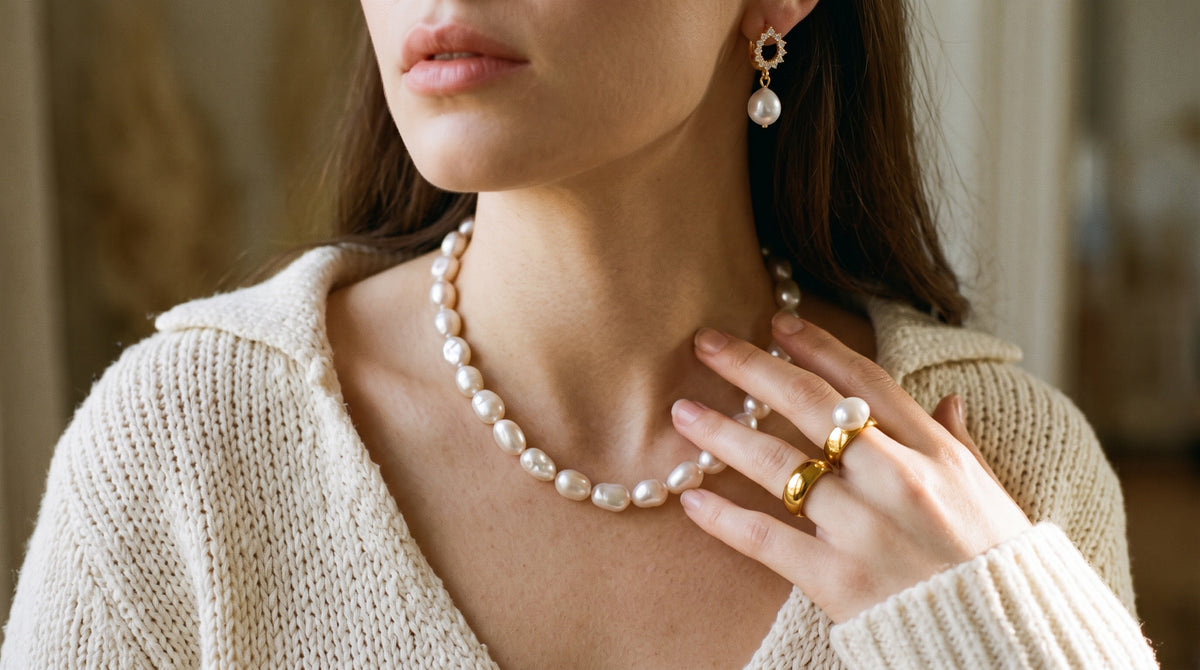
- Choker, 14 to 16 in (35 to 41 cm): sits at the base of the neck, ideal with open collars, boat necks and strapless tops. A pearl choker works on its own or as the shortest layer.
- Princess, 17 to 19 in (43 to 48 cm): the classic length, resting on the collarbone, easy with crew necks and V-necks.
- Matinee, 20 to 24 in (51 to 61 cm): falls on the upper chest, good over a shirt or a simple knit.
- Opera and rope, 28 in (71 cm) and longer: worn long, doubled or knotted, over a turtleneck or a dress.
Mix pearls with gold chains
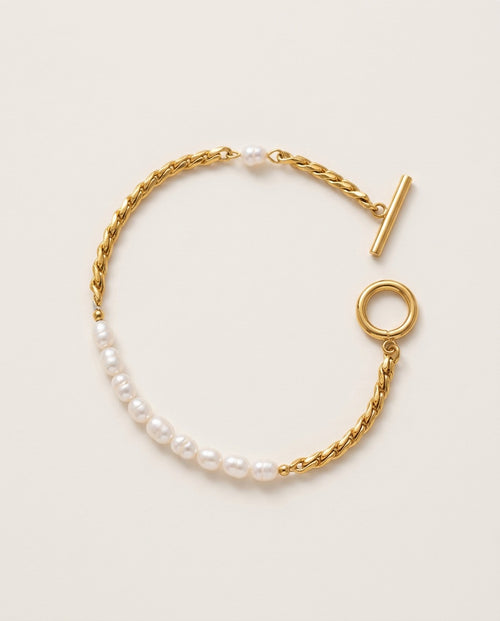
The most current way to wear pearls is to layer them with fine gold chains: a short pearl strand, then a chain with a small pendant, then a longer piece. A long pearl necklace can also be wrapped twice to sit at two lengths. Keep one element dominant so the layers do not compete.
Pearls for every day and for men
Single pearl studs or gold pearl earrings work with jeans as well as with a suit, and a pearl ring adds softness to a stack of plain bands. Pearl necklaces have also found a place in menswear, usually as a short, slightly irregular strand worn with an open collar. For where pearls sit among this season's styles, see our jewelry trends guide.
How to clean pearls and keep their luster
Pearls are soft, around 2.5 to 4.5 on the Mohs scale, and their nacre reacts to acids, perfume, hairspray and sweat. Good habits matter more than any deep cleaning.
- Last on, first off: put pearls on after makeup, perfume and lotion, and take them off first.
- Wipe after wearing with a soft cloth, slightly damp with plain water, then let them dry flat.
- Never soak a strand and never use an ultrasonic cleaner, steam, vinegar or jewelry dip.
- Store them flat and separately in a soft pouch, away from harder jewelry that could scratch them, and not sealed in an airtight bag for long periods.
- Have strands restrung when the thread looks stretched or dirty between the knots.

For mixed pieces where pearls sit on a chain or a ring setting, our guide on how to clean jewelry at home explains how to clean the metal without wetting the pearls.
Choosing a pearl necklace as a gift
Start with the person's style rather than the type of pearl. Someone who wears minimal jewelry will reach daily for a short, simple strand or a single pearl on a chain; someone who loves statement pieces will enjoy larger or baroque pearls.
- For a first pearl piece: a princess-length strand or pearl studs, both easy to wear.
- For a bride: a short strand or drops that echo the neckline of the dress.
- For a 30th anniversary: a piece she can wear often, rather than one kept for rare occasions.
You can compare styles and lengths in our pearl necklaces collection.
FAQ
Are pearls bad luck?
Some old superstitions link pearls to tears, especially at weddings. Others see them as protective and lucky. These are traditions only, and pearls remain one of the most popular bridal jewels.
Can you wear pearls every day?
Yes, as long as you follow the last-on, first-off rule and wipe them after wearing. Daily wear actually suits pearls better than long storage in a dry, sealed box.
Can you shower or swim with pearls?
It is best not to. Chlorine, salt and soap residue dull nacre, and water weakens the thread of a strand. Take pearls off before showering, swimming or exercising.
What does a black pearl mean?
Dark pearls are often associated with mystery, independence and protection in modern jewelry symbolism. Naturally dark pearls usually come from Tahitian oysters, while many affordable black pearls are dyed freshwater or imitation pearls.